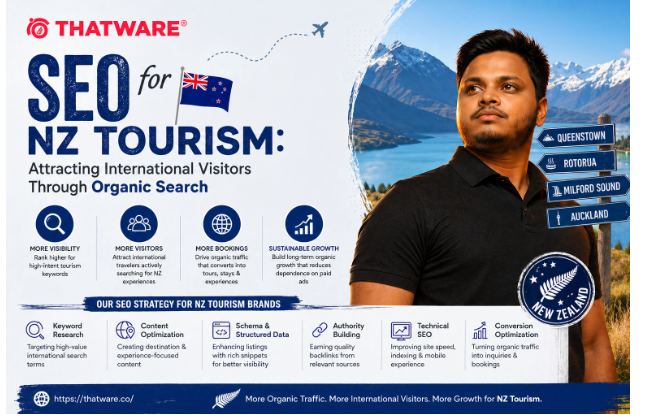
New Zealand’s tourism sector has a specific organic search challenge that’s different from most industries: the people searching are overwhelmingly not in New Zealand. International visitors planning a trip to New Zealand are searching from Australia, the UK, the US, Europe, and increasingly from China, Japan, and South Korea. The geographic and language complexity of that audience is significant.
And the competitive landscape is unusual – NZ tourism businesses are competing not just against each other but against large international travel aggregators (Booking.com, TripAdvisor, Lonely Planet) that have enormous domain authority and highly optimized NZ content.
Understanding the International Visitor Search Journey
The journey from initial inspiration to actual booking typically runs through several distinct search stages, each with different intent and different content requirements. The inspiration stage – “places to visit in New Zealand,” “New Zealand travel itinerary” – is dominated by travel media and aggregators. Most NZ tourism businesses can’t compete for these broad informational queries.
The planning stage – “best things to do in Queenstown,” “Milford Sound day trip options,” “South Island self-drive route” – is where specificity creates opportunity. SEO services new zealand for tourism operators focus here: the specific, experience-level queries where local knowledge creates genuine differentiation that aggregators can’t replicate from their generic editorial perspective.
The Content Strategy That Works for NZ Tourism Operators
Specific experience content – detailed, authentic, locally knowledgeable – consistently outranks generic destination content for conversion-intent queries. A guided kayaking operator in Abel Tasman can produce content about the specific experience of kayaking the Abel Tasman in different seasons, what to expect on specific routes, how it compares to other coastal experiences in New Zealand – that type of content that no aggregator will produce at the same level of specificity.
That specificity serves two functions. It ranks for the specific queries it addresses. And it converts better than generic content because it demonstrates actual local knowledge and helps the reader evaluate whether the specific experience is right for them.
Language and Localization Considerations for International Audiences
An seo agency new zealand working with tourism operators serving international audiences needs to think carefully about language and cultural specificity. Australian visitors searching for NZ travel content have slightly different query patterns than UK visitors or US visitors. Climate terminology differs – “winter” means different things at different latitudes. Activity preferences vary by source market.
For operators with meaningful visitor diversity, producing content specifically for the highest-value source markets – with language and cultural calibration beyond just spelling differences – can produce measurable improvements in qualified traffic from those markets.
Google Business Profile for Tourism: Different Rules
Tourism businesses have specific Google Business Profile considerations that differ from standard local businesses. The review ecosystem for tourism is typically more influential – international visitors rely heavily on reviews when they can’t evaluate options through local knowledge. The photo content is more impactful – people are making visual decisions about experiences they’ve never had. The Q&A section is more actively used – travelers ask practical planning questions that the operator has the opportunity to answer visibly.
All of these require more active and sophisticated GBP management than a domestic-focused local business typically needs.
The Long-Tail Opportunity That Most NZ Tourism Operators Miss
The highest-conversion search queries in NZ tourism are typically very specific long-tail searches that national tourism boards and aggregators don’t optimize for. “Multi-day kayak Abel Tasman independent,” “Routeburn Track booking availability,” “boutique Marlborough wine tour private” – these are small volume but high intent, with low competition. A well-structured content program that systematically addresses these queries builds cumulative traffic from audiences that are actively planning rather than passively browsing.